
Brand strategy: what it is, what it includes and how to build one step by step

Vera Negru
By Vera Negru, Founder & Lead Strategist, Marketicious

A brand strategy is the set of decisions that defines who your brand is for, what problem it solves, why someone should choose you and what you won't do - not even to grow faster. It isn't a logo, a color palette or a tagline. It's the filter every marketing decision and every dollar of budget should pass through.

In 16 years of marketing, I've seen the same pattern in very different businesses: the budget grows, the campaigns multiply, but results reset every quarter. Almost every time, the problem wasn't execution. What was missing was a strategy that said what to do and, more importantly, what not to do.

What is a brand strategy?

A brand strategy is the decision plan that gets a brand chosen for the right reasons, by the right people, again and again. It defines the position you hold in the customer's mind and the rules you follow to keep it.

The simplest test: a good brand strategy helps you turn things down. If your strategy document has never made you say "no" to an opportunity, a channel or a client, it's a list of intentions, not a strategy.

In practice, a brand strategy answers five questions:

  • Who are we for? And, just as important, who are we not for.
  • What problem do we solve? In the customer's words, not our jargon.
  • Why us? A reason that still holds when a competitor copies you.
  • What do we say, and how? The message and tone that make the brand recognizable.
  • What won't we do? The lines you don't cross, not even to grow faster.

What's the difference between branding and brand strategy?

Branding is the visible expression of a brand: name, logo, colors, fonts, tone. Brand strategy is the thinking behind them. Branding answers "how do we look?", strategy answers "what do we choose, and why?"

BrandingBrand strategy
The question it answersHow do we look and sound?Who are we for, and why would anyone choose us?
What it producesLogo, visual identity, tone, materialsPositioning, audience, message, priorities, limits
Who sees itEveryoneMainly the team and partners
When it changesCan be refreshed oftenReviewed rarely, when the market or the business changes
How you know it worksThe brand is recognizedThe brand is chosen, recommended and bought again

Order matters: strategy comes first. A beautiful logo on top of unclear positioning looks great in a presentation and changes nothing in sales.

What does a brand strategy include?

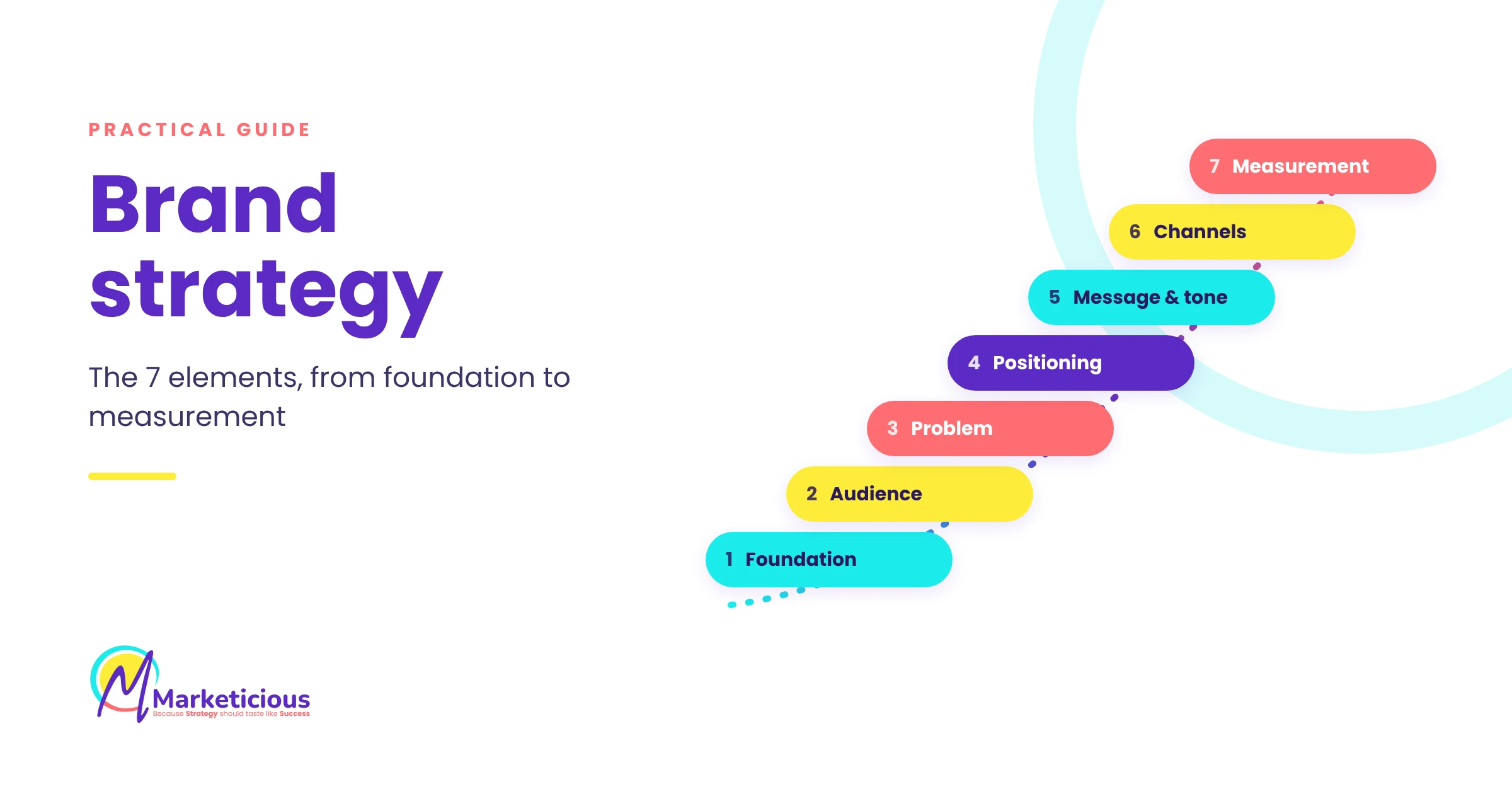
A complete brand strategy has seven elements. Each one answers a question, and each depends on the one before it.

ElementKey questionConcrete output
1. FoundationWhat do we stand for, and what do we refuse to do?A few principles and the brand's clear limits
2. AudienceWho are we for, and who are we not for?The core customer, described by problems and behaviors, not just age and city
3. ProblemWhat hurts the customer, in their words?The problem phrased the way they'd tell a friend
4. PositioningWhy us and not someone else?A positioning statement that survives a copycat competitor
5. Message & toneWhat do we say, and how do we sound?The core message, 3-4 supporting messages and tone rules
6. ChannelsWhere do we meet our audience, and how do we grow?Priority channels, chosen by positioning, not by trend
7. MeasurementHow do we know it's working?KPIs by stage and a review rhythm

How do you build a brand strategy, step by step?

The steps follow the order of the 7 elements. Don't skip the first three: everything else rests on them.

  1. 01
    Separate how you look from what you decide. Look at your recent marketing decisions: did they start from a clear rule about who you are, or from "let's try it"?
  2. 02
    Define who the brand is for, and who it isn't for. "Everyone" is not an audience. The sentence about who isn't your customer will save you from many wasted campaigns.
  3. 03
    Nail your "why you". If a competitor could say the exact same sentence, you don't have positioning yet.
  4. 04
    Use positioning as a filter before any budget. This is where most brands leak: the strategy is written, but the budget gets spent by other criteria.
  5. 05
    Choose channels by positioning, not by trend. Every channel has to serve your message, not just bring traffic.
  6. 06
    Measure what matters. KPIs by stage: awareness, conversion, retention. Any number that doesn't change a decision can come out of the report.
  7. 07
    Turn the strategy into a 90-day plan. Not a three-year plan. Three priorities, one review at the end.

Each step looks simple on paper. The hard part is applying it to your own brand and being honest about what you need to turn down.

An example: what a brand strategy looks like in practice

A fictional physiotherapy clinic, with good services but no growth:

BeforeAfter
Who it's for"Anyone who needs recovery"Amateur runners who want to get back to training
Why us"Experienced team, modern equipment"Recovery built around getting back to the sport
What it says "no" to-Generic massage packages and discounts on deal sites
What it measuresNumber of appointmentsPatients who complete the program, and referrals

The clinic didn't change its logo. It changed its decisions.

Leave a comment