
What is a brand strategy?
A brand strategy is the decision plan that gets a brand chosen for the right reasons, by the right people, again and again. It defines the position you hold in the customer's mind and the rules you follow to keep it.
The simplest test: a good brand strategy helps you turn things down. If your strategy document has never made you say "no" to an opportunity, a channel or a client, it's a list of intentions, not a strategy.
In practice, a brand strategy answers five questions:
- Who are we for? And, just as important, who are we not for.
- What problem do we solve? In the customer's words, not our jargon.
- Why us? A reason that still holds when a competitor copies you.
- What do we say, and how? The message and tone that make the brand recognizable.
- What won't we do? The lines you don't cross, not even to grow faster.
What's the difference between branding and brand strategy?
Branding is the visible expression of a brand: name, logo, colors, fonts, tone. Brand strategy is the thinking behind them. Branding answers "how do we look?", strategy answers "what do we choose, and why?"
| Branding | Brand strategy | |
|---|---|---|
| The question it answers | How do we look and sound? | Who are we for, and why would anyone choose us? |
| What it produces | Logo, visual identity, tone, materials | Positioning, audience, message, priorities, limits |
| Who sees it | Everyone | Mainly the team and partners |
| When it changes | Can be refreshed often | Reviewed rarely, when the market or the business changes |
| How you know it works | The brand is recognized | The brand is chosen, recommended and bought again |
Order matters: strategy comes first. A beautiful logo on top of unclear positioning looks great in a presentation and changes nothing in sales.
What does a brand strategy include?
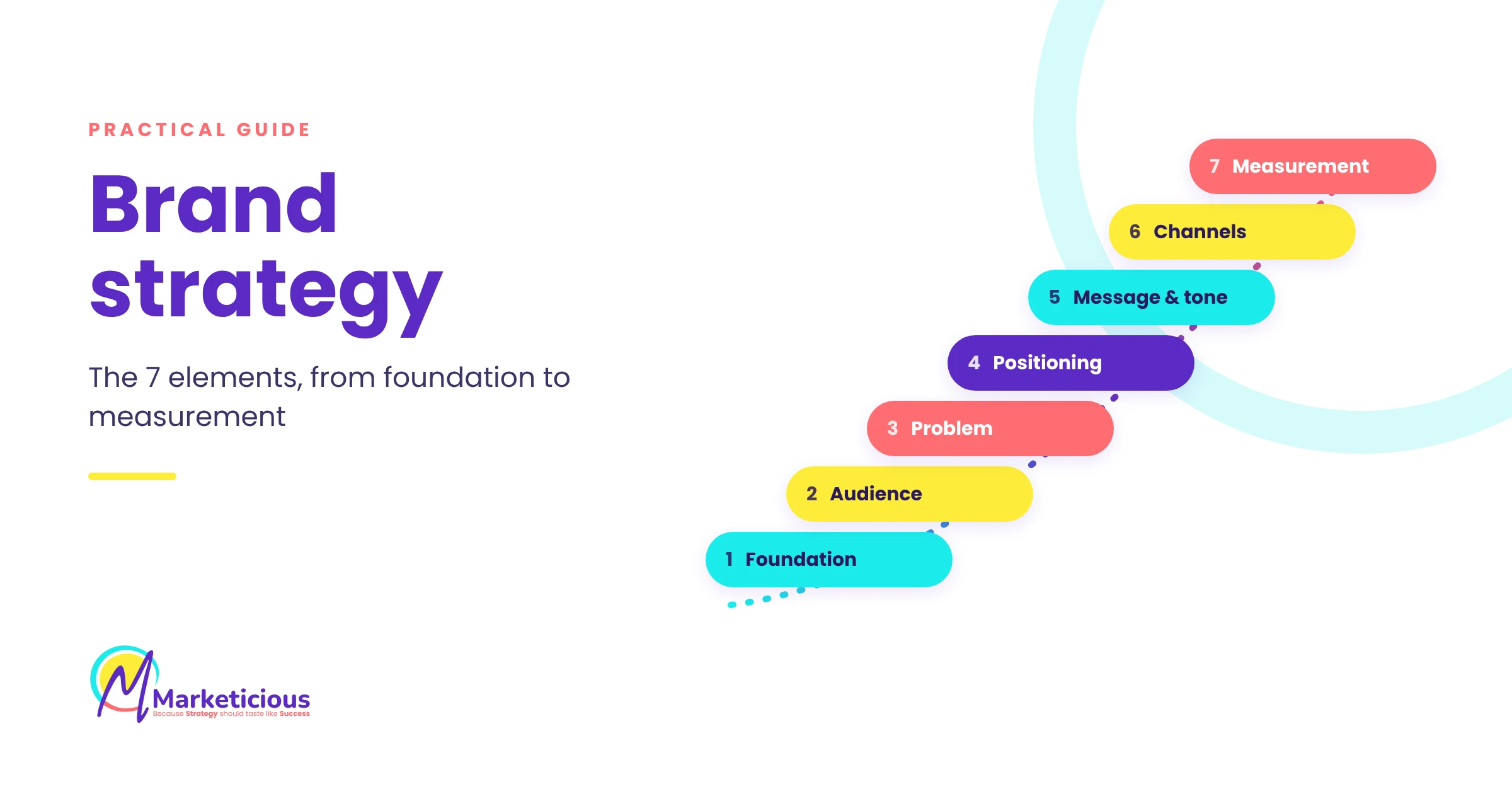
A complete brand strategy has seven elements. Each one answers a question, and each depends on the one before it.
| Element | Key question | Concrete output |
|---|---|---|
| 1. Foundation | What do we stand for, and what do we refuse to do? | A few principles and the brand's clear limits |
| 2. Audience | Who are we for, and who are we not for? | The core customer, described by problems and behaviors, not just age and city |
| 3. Problem | What hurts the customer, in their words? | The problem phrased the way they'd tell a friend |
| 4. Positioning | Why us and not someone else? | A positioning statement that survives a copycat competitor |
| 5. Message & tone | What do we say, and how do we sound? | The core message, 3-4 supporting messages and tone rules |
| 6. Channels | Where do we meet our audience, and how do we grow? | Priority channels, chosen by positioning, not by trend |
| 7. Measurement | How do we know it's working? | KPIs by stage and a review rhythm |


